The royal hunt and Marie-Josèphe’s escape from her pursuers
The Moon and the SunThe royal hunt and Marie-Josèphe’s escape from her pursuers turns a royal spectacle into a double crisis: Louis XIV’s first shot releases the hunting party into a mass killing, while Marie-Josèphe’s attempt to get away from the hunt becomes a pursuit by men of the court. Her escape on Zachi restores her immediate freedom, but the scene ends with her distress and an injury that Count Lucien de Barenton, Count de Chrétien, notices and offers to treat.
The King’s hunt
The episode begins as an ancient aurochs, having escaped from the Menagerie of Versailles, emerges from the forest. The hunting party responds with amazement and appreciation. The animal tears through the ground and vegetation as it moves, while the hunters hold their fire, acknowledging the King’s right to take the bull. The spectacle is organized around royal precedence: the other hunters wait for Louis XIV to make the first shot.
The aurochs charges the royal carriage, and Louis XIV fires. Wounded, it continues toward him, so Count Lucien calmly hands the King another loaded gun. Louis XIV fires again, and once more, before the aurochs falls in front of him. The hunters cheer the King’s shooting. The sequence gives the hunt a clear turning point: the King’s first kill is followed by volleys against the animals pouring out of the forest.
Camels, stags, rabbits, a fox, Arabian oryxes, peacocks, grouse, and other birds spill into the hunting field as gunfire overtakes the beaters’ noise. The hunters shoot as attendants supply loaded guns; animals fall amid the confusion. Madame also takes aim and kills a fox. The scene contrasts the party’s admiration of the aurochs as an exotic creature with the indiscriminate firing that follows. Once the King has taken his quarry, the hunt becomes a spectacle of repeated killing rather than a single royal encounter.
The hunt becomes a pursuit
Against this background of noise and disorder, the Duke of Chartres turns his attention from the animals to Marie-Josèphe. He reaches for the lace of her petticoat, and she knocks his hand away. He then makes clear that he has found another quarry more to his liking. When she tries to move Zachi away, the Chevalier de Lorraine blocks the route; the Duke of Chartres pulls at her clothing, and the Chevalier pulls a pin from her hair. The hunt’s excitement has become an opportunity for the men to harass and impede her.
Marie-Josèphe urges Zachi forward, but Berwick’s charger steps in front of them. The Duke of Chartres tears at her clothing again, while the Chevalier pulls at her sleeve, aggravating the discomfort of her already injured arm. The episode does not present these actions as a contest between equal riders: the men obstruct her movement, while Marie-Josèphe must find a way through the chaos to escape. Her resistance is immediate, but the riders’ pursuit makes flight her only practical means of getting clear.
Zachi carries her clear
When grouse burst from the underbrush, the startled horses shift position. Marie-Josèphe uses the opening to touch Zachi’s mouth with the reins. The mare backs, rears, turns, and breaks into a gallop. The Duke of Chartres, Berwick, and the Chevalier de Lorraine follow. Zachi passes gamesmen opening wicker baskets and releasing turkeys; even as the birds rise into the hunters’ range, she does not falter.
The pursuing hoofbeats draw close. The Duke of Chartres catches the hem of Marie-Josèphe’s habit and nearly unseats her, but she holds her place on the sidesaddle and urges Zachi to run. Zachi outdistances the larger horses. As the pursuers’ sounds recede, their laughter gives way to irritation and anger; Marie-Josèphe is left alone with the mare. The escape is therefore not a rescue by the hunting party or an end to the hunt’s violence. It is achieved through Zachi’s speed and Marie-Josèphe’s insistence that the mare keep going.
Once clear, Marie-Josèphe lets Zachi slow from a run to a canter, then a trot and a walk along the manicured trails. She speaks to the mare with admiration, recognizing that she could not afford to keep her as Count Lucien could and that she would grieve when she had to return her. Count Lucien appears from a side trail as she speaks of him. His arrival changes the scene from solitary flight to an encounter with someone she trusts enough to address, though her distress soon overwhelms her composure.
Lucien’s care and the scene’s aftermath
Count Lucien lightly warns that her habit of speaking to animals may earn her an unwelcome reputation. The exchange gives way to Marie-Josèphe’s anger and frustration: her hair is loose, her lace is ruined, and her left arm aches. She tries to gather her hair and straighten her torn cravat, then bursts into tears. Humiliated, she turns away from him and worries that he sees her only when she needs help, cries, or makes a fool of herself.
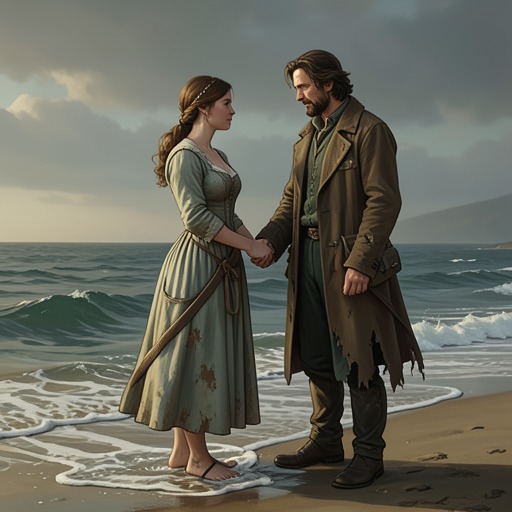
Count Lucien reassures her that, although he is a dangerous man, she will not be in danger from him. He ties back her hair with his own ribbon and lets his chestnut peruke fall free around his shoulders. The small, practical gesture answers the disorder of her appearance without dismissing her distress. Marie-Josèphe says she had thought the Duke of Chartres sweet and asks what she did to make him behave as he did; the scene supplies no cause for his conduct, only the contrast between her former impression of him and his actions during the hunt.
When Count Lucien takes her hand, Marie-Josèphe tries to withdraw it and says she is well. He sharply tells her to be still and examines her wrist. The bandage is stuck to her skin, and the marks beneath it have darkened; her arm throbs. Count Lucien turns pale at the sight of blood and offers to send to his lodge for M. de Baatz’ salve, which he says helped him earlier in the summer. The episode ends with that offer, not with a stated recovery. Its final movement is from public violence and pursuit to private attention: Marie-Josèphe has escaped the riders, but she remains hurt and shaken.
Significance
The episode joins two forms of pursuit without treating them as equivalent. The royal hunt is sanctioned entertainment, governed by the King’s right to the first shot; the pursuit of Marie-Josèphe is a threat she resists by escaping. The first turns the animals emerging from the forest into targets, while the second makes Marie-Josèphe herself the object of unwanted attention. Her flight breaks away from both the hunting party’s collective violence and the men who follow her.
Zachi’s role gives the escape its decisive means: the mare remains sure-footed amid released birds, gunfire, and pursuing horses, and carries Marie-Josèphe beyond their reach. The encounter with Count Lucien then shifts the focus from escape to trust and care. His ribbon and attention to her arm offer immediate comfort, but do not erase the humiliation or establish what will happen to the injury. The scene closes on a limited reprieve: Marie-Josèphe is out of reach of her pursuers, with her distress acknowledged by someone who offers practical help.